

Scientific evidence

Consensus and guidelines on phytosterols in lipid management

More than 200 studies confirm the effectiveness of phytosterols in lowering cholesterol levels.

According to several international medical associations, a daily consumption of 2 grams of phytosterols is recommended to achieve this goal.


Health Canada<br />
(Canada)
American Hearth Association<br />
(United States)
European Society of Cardiology (ESC)<br />
(Europe)
European Atherosclerosis Society (EAS)<br />
(Europe)

International Guidelines

Canadian Cardiovascular Society

En 2021
Nous recommandons les composants alimentaires suivants pour réduire le C-LDL :
Régimes alimentaires avec stérols/stanols végétaux (≥ 2g/jour). Forte recommandation, preuves de haute qualité.

En 2022
Selon les évidences scientifiques, les stérols végétaux contribuent à une amélioration du C-LDL-C, il est recommandé de les inclure dans l’approche diététique. Les phytostérols (stérols et stanols) sont des composés bioactifs présents dans les plantes. Il a été démontré qu’un apport de 2g/j entraîne une baisse de 8% à 10% du C-LDL, même chez les personnes recevant un traitement par statine.

Pearson GJ, et al. 2021 Canadian Cardiovascular Society guidelines for the management of dyslipidemia for the prevention of cardiovascular disease in the adult: supplementary material. Can J Cardiol 2021; S0828-282X (21)00165-3.

American Heart Association

À partir de 2006
L’American Heart Association recommande :

  • Les stanols/stérols végétaux diminuent les taux de C-LDL jusqu’à 15 % et sont donc considérés comme une option thérapeutique, en plus de la modification du régime alimentaire et du mode de vie, pour les personnes ayant des taux élevés de C-LDL.
  • Les effets optimaux sont observés dans le cas d’un apport de 2 g de stanols ou de stérols végétaux par jour.
  • Le choix du véhicule doit être déterminé par la disponibilité et d’autres considérations, notamment la teneur calorique.

Lichtenstein AH, et al. Diet and lifestyle recommendations revision 2006: a scientific statement from the American Heart Association Nutrition Committee. Circulation 2006;114:82-96.

European Society of Cardiology (ESC)
European Atherosclerosis Society (EAS)

En 2019
Les directives révisées de l’ESC/EAS pour la prise en charge des dyslipidémies comprenaient pour la première fois une recommandation pour les stérols végétaux dans le cadre des changements de mode de vie, visant à réduire les taux de cholestérol sérique.

Les directives conjointes ESC/EAS recommandent une supplémentation en phytostérols de 2 g chez les personnes ayant un taux de cholestérol élevé :

  • Dont le risque cardiovasculaire est intermédiaire ou faible;
  • Qui ne sont pas admissibles à une pharmacothérapie;
  • Considérées à risque élevé ou très élevé et qui ne parviennent pas à atteindre les cibles de C-LDL;
  • Qui ne peuvent pas être traitées par des statines;
  • Atteintes d’hypercholestérolémie familiale.

Mach F, et al. 2019 ESC/EAS Guidelines for the management of dyslipidaemias: lipid modification to reduce cardiovascular risk. European Heart Journal 2020;41:111-188.

Cardiosmile Pivotal Trials

Efficacy results from Shaghaghi, et al.

A Canadian clinical study
After 28 days of consumption, Cardiosmile :
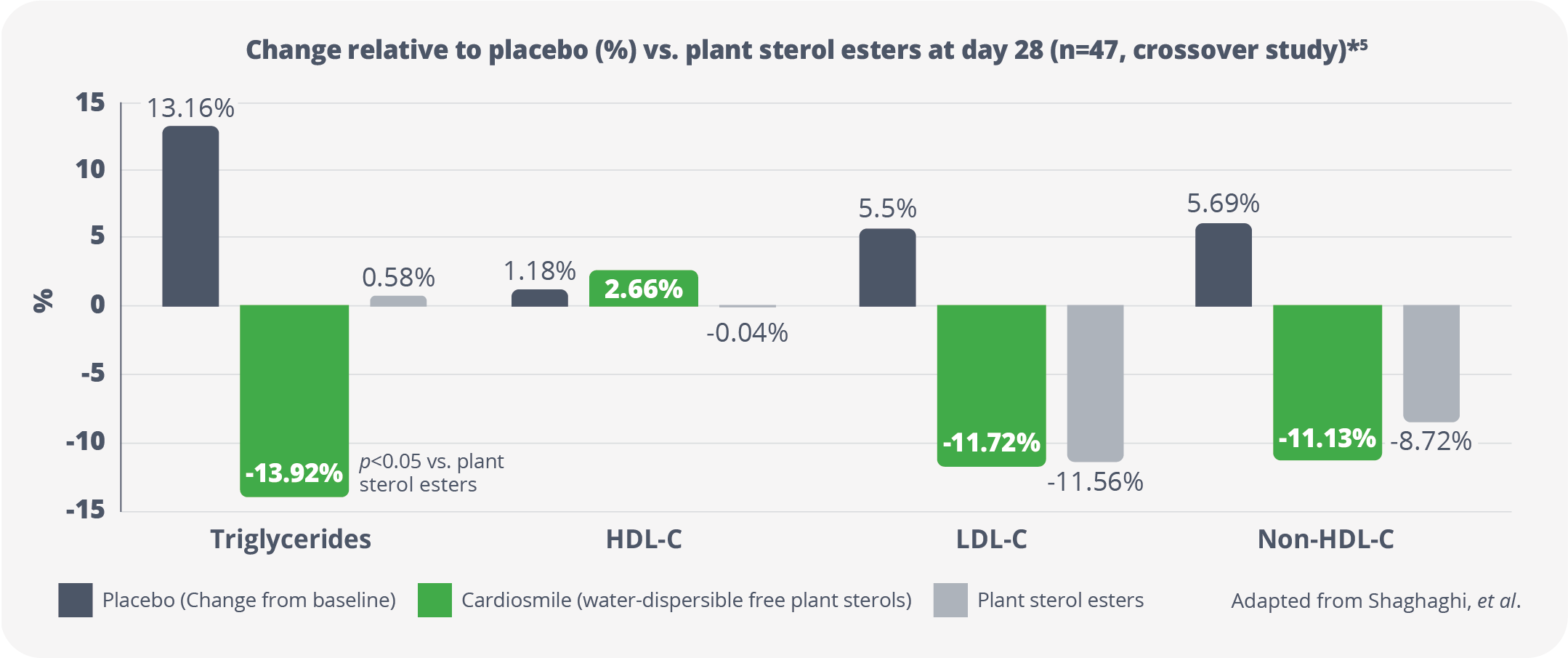
Lower triglycerides by

-13,90%

compared to 0.6% plant sterol esters (PS-esters); p<0.05 (comparison of Cardiosmile with PS-esters is significant, but n/s from placebo)

Increase HDL-C by

+2,66%

compared to -0.04 for plant sterol esters; n/s.

Lower LDL-C by

-11,70%

compared to 11.6% for plant sterol esters; p<0.001 compared to placebo.

Lower non-HDL-C by

-11,13%

compared to 8.72% for plant sterol esters; p<0.001 compared to placebo.

Supplementation of Cardiosmile and PS-ester did not adversely influence fat soluble vitamin or carotenoid levels before or after adjustment for LDL-C levels, compared to control.1

Cardiosmile and PS-ester favorably modified blood lipid profiles without altering plasma liver enzymes or CRP concentrations.1

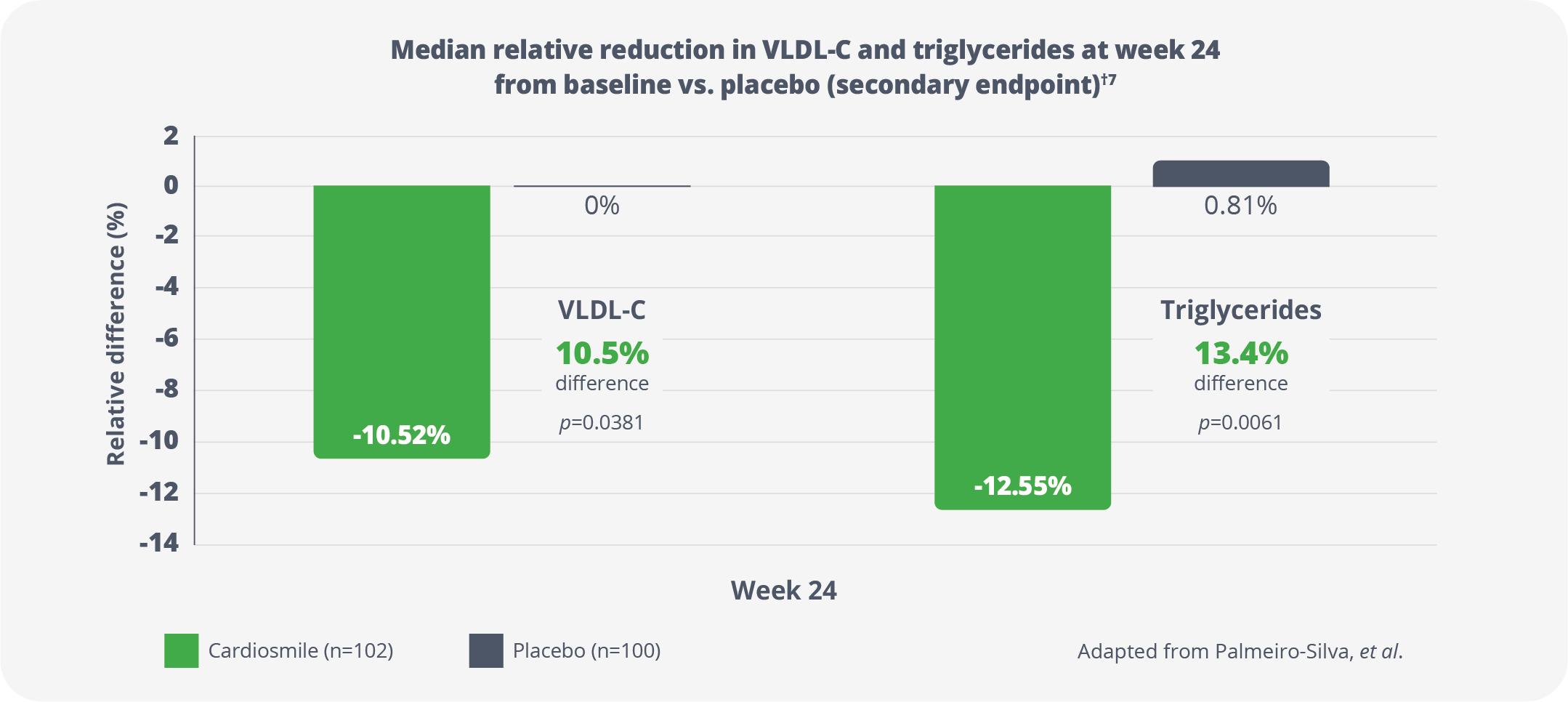
Efficacy results from Palmeiro-Silva, et al.

Effects of daily consumption of an aqueous dispersion of free phytosterol nanoparticles on individuals with metabolic syndrome: a randomized, double-blind, placebo-controlled clinical trial.

Safety profile in clinical trials:

  • Supplementation of Cardiosmile and PS-ester did not adversely influence fat soluble vitamin or carotenoid levels before or after adjustment for LDL-C levels, compared to control.2
  • No negative effect on plasma vitamin D levels was observed.2
  • At week 24, Cardiosmile demonstrated a 68% improvement in bowel habits (relieving constipation) from visit 1 (p=0.001).2
Health Canada’s assessment of foods containing plant sterols and blood cholesterol lowering

Health Canada’s assessment of foods containing plant sterols and blood cholesterol lowering

According to guidelines established by Health Canada, plant sterols are considered safe cholesterol-lowering ingredients.3

A Health Canada safety assessment of the addition of plant sterols to foods raised no safety concerns with plant sterol intakes ≤3 g (as free phytosterols) per day in adults and ≤1 g in children.3

Published studies have demonstrated that consuming 3 g of phytosterols/day posed no nutritionalrisk for the general population with respect to beta-carotene.4

1. Shaghaghi MA, et al. Water dispersible plant sterol formulation shows improved effect on lipid profile compared to plant sterol esters. J Funct Foods 2014;(6):280-289.
2. Palmeiro-Silva YK, et al. Effects of daily consumption of an aqueous dispersion of free-phytosterols nanoparticles on individuals with metabolic syndrome: a randomised, double-blind, placebo-controlled clinical trial. Nutrients 2020;12:2392; doi:10.3390/nu12082392.
3. Government of Canada. General questions and answers about plant sterols. Accessed March 2023 at: www.canada.ca/en/health-canada/services/food-nutrition/food-labelling/nutritionlabelling/general-questions-answers-plant-sterols-nutrition-claims.html.
4. Government of Canada. Notice of safety assessment of certain classes of foods containing added phytosterols. Accessed March 2023 at: https://www.canada.ca/fr/sante-canada/services/aliments-nutrition/aliments-genetiquement-modifiesautres-aliments-nouveaux/produits-approuves/avis-evaluation-certaines-categories-aliments-contenant-phytosterols-ajoutes.html.