

Scientific evidence

Consensus and guidelines on phytosterols in lipid management

More than 200 studies confirm the effectiveness of phytosterols in lowering cholesterol levels.

According to several international medical associations, a daily consumption of 2 grams of phytosterols is recommended to achieve this goal.


Health Canada<br />
(Canada)
American Hearth Association<br />
(United States)
European Society of Cardiology (ESC)<br />
(Europe)
European Atherosclerosis Society (EAS)<br />
(Europe)

International Guidelines

Canadian Cardiovascular Society

In 2021
We recommend the following food components to reduce LDL-C:
Diets containing plant sterols/stanols (≥ 2 g/day). Highly recommended, supported by high-quality evidence.

In 2022
According to scientific evidence, plant sterols contribute to improving LDL-C. As such, their inclusion in dietary approaches is recommended. Phytosterols (sterols and stanols) are bioactive compounds found in plants. Studies have shown that an intake of 2 g per day results in an 8% to 10% drop in LDL-C, even in people receiving statin treatment.

Pearson GJ, et al. 2021 Canadian Cardiovascular Society guidelines for the management of dyslipidemia for the prevention of cardiovascular disease in the adult: supplementary material. Can J Cardiol 2021; S0828-282X (21)00165-3.

American Heart Association

Since 2006
The American Heart Association has recommended:

  • Plant stanols/sterols reduce LDL-C levels by up to 15% and are therefore considered a therapeutic option for people with high LDL-C levels when combined with diet and lifestyle changes.
  • Optimal effects are observed with an intake of 2 g of plant stanols or sterols per day.
  • The choice of vehicle should be determined by availability and other considerations, including calorie content.

Lichtenstein AH, et al. Diet and lifestyle recommendations revision 2006: a scientific statement from the American Heart Association Nutrition Committee. Circulation 2006;114:82-96.

European Society of Cardiology (ESC)
European Atherosclerosis Society (EAS)

In 2019
For the first time, revised ESC/EAS guidelines for the management of dyslipidaemia included a recommendation to include plant sterols as part of lifestyle changes aimed at reducing serum cholesterol levels.

Joint ESC/EAS guidelines recommend phytosterol supplementation of 2 g per day for people with high cholesterol levels:

  • Who have low or moderate cardiovascular risk;
  • Who are not eligible for drug therapy;
  • Who are considered at high or very high risk and are unable to reach LDL-C targets;
  • Who cannot be treated with statins;
  • Who suffer from familial hypercholesterolemia.

Mach F, et al. 2019 ESC/EAS Guidelines for the management of dyslipidaemias: lipid modification to reduce cardiovascular risk. European Heart Journal 2020;41:111-188.

Cardiosmile Pivotal Trials

Efficacy results from Shaghaghi, et al.

A Canadian clinical study
After 28 days of consumption, Cardiosmile :
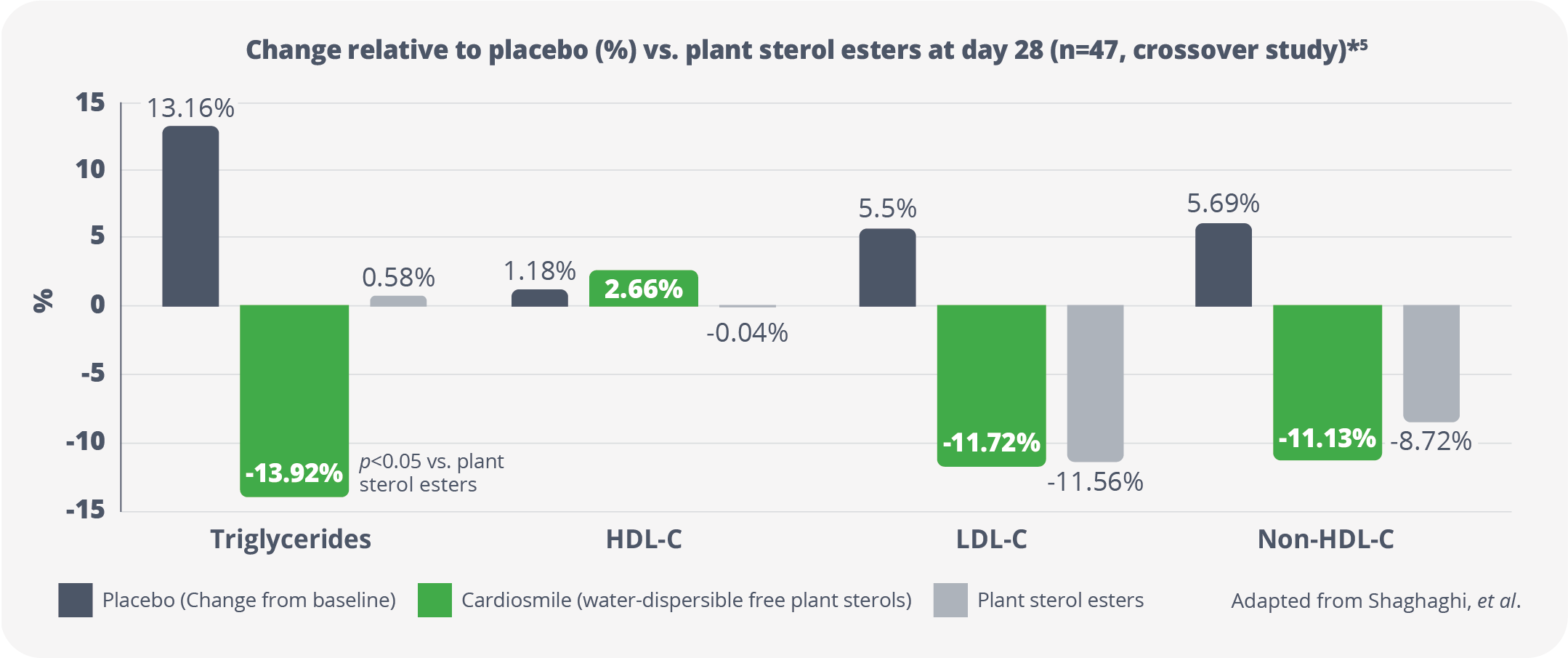
Lower triglycerides by

-13,90%

compared to 0.6% plant sterol esters (PS-esters); p<0.05 (comparison of Cardiosmile with PS-esters is significant, but n/s from placebo)

Increase HDL-C by

+2,66%

compared to -0.04 for plant sterol esters; n/s.

Lower LDL-C by

-11,70%

compared to 11.6% for plant sterol esters; p<0.001 compared to placebo.

Lower non-HDL-C by

-11,13%

compared to 8.72% for plant sterol esters; p<0.001 compared to placebo.

Supplementation of Cardiosmile and PS-ester did not adversely influence fat soluble vitamin or carotenoid levels before or after adjustment for LDL-C levels, compared to control.1

Cardiosmile and PS-ester favorably modified blood lipid profiles without altering plasma liver enzymes or CRP concentrations.1

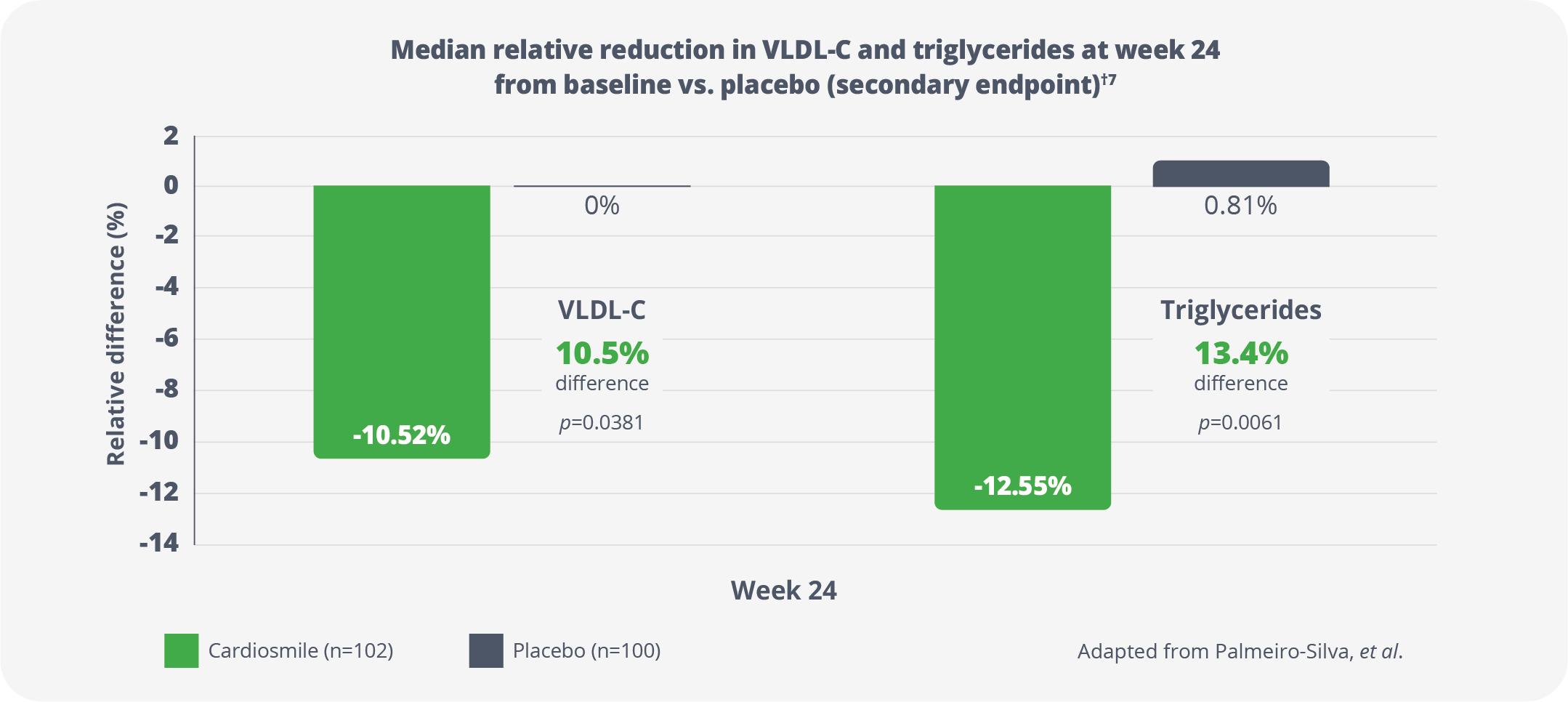
Efficacy results from Palmeiro-Silva, et al.

Effects of daily consumption of an aqueous dispersion of free phytosterol nanoparticles on individuals with metabolic syndrome: a randomized, double-blind, placebo-controlled clinical trial.

Safety profile in clinical trials:

  • Supplementation of Cardiosmile and PS-ester did not adversely influence fat soluble vitamin or carotenoid levels before or after adjustment for LDL-C levels, compared to control.2
  • No negative effect on plasma vitamin D levels was observed.2
  • At week 24, Cardiosmile demonstrated a 68% improvement in bowel habits (relieving constipation) from visit 1 (p=0.001).2
Health Canada’s assessment of foods containing plant sterols and blood cholesterol lowering

Health Canada’s assessment of foods containing plant sterols and blood cholesterol lowering

According to guidelines established by Health Canada, plant sterols are considered safe cholesterol-lowering ingredients.3

A Health Canada safety assessment of the addition of plant sterols to foods raised no safety concerns with plant sterol intakes ≤3 g (as free phytosterols) per day in adults and ≤1 g in children.3

Published studies have demonstrated that consuming 3 g of phytosterols/day posed no nutritionalrisk for the general population with respect to beta-carotene.4

1. Shaghaghi MA, et al. Water dispersible plant sterol formulation shows improved effect on lipid profile compared to plant sterol esters. J Funct Foods 2014;(6):280-289.
2. Palmeiro-Silva YK, et al. Effects of daily consumption of an aqueous dispersion of free-phytosterols nanoparticles on individuals with metabolic syndrome: a randomised, double-blind, placebo-controlled clinical trial. Nutrients 2020;12:2392; doi:10.3390/nu12082392.
3. Government of Canada. General questions and answers about plant sterols. Accessed March 2023 at: www.canada.ca/en/health-canada/services/food-nutrition/food-labelling/nutritionlabelling/general-questions-answers-plant-sterols-nutrition-claims.html.
4. Government of Canada. Notice of safety assessment of certain classes of foods containing added phytosterols. Accessed March 2023 at: https://www.canada.ca/fr/sante-canada/services/aliments-nutrition/aliments-genetiquement-modifiesautres-aliments-nouveaux/produits-approuves/avis-evaluation-certaines-categories-aliments-contenant-phytosterols-ajoutes.html.